
unknownPosters & Visuals
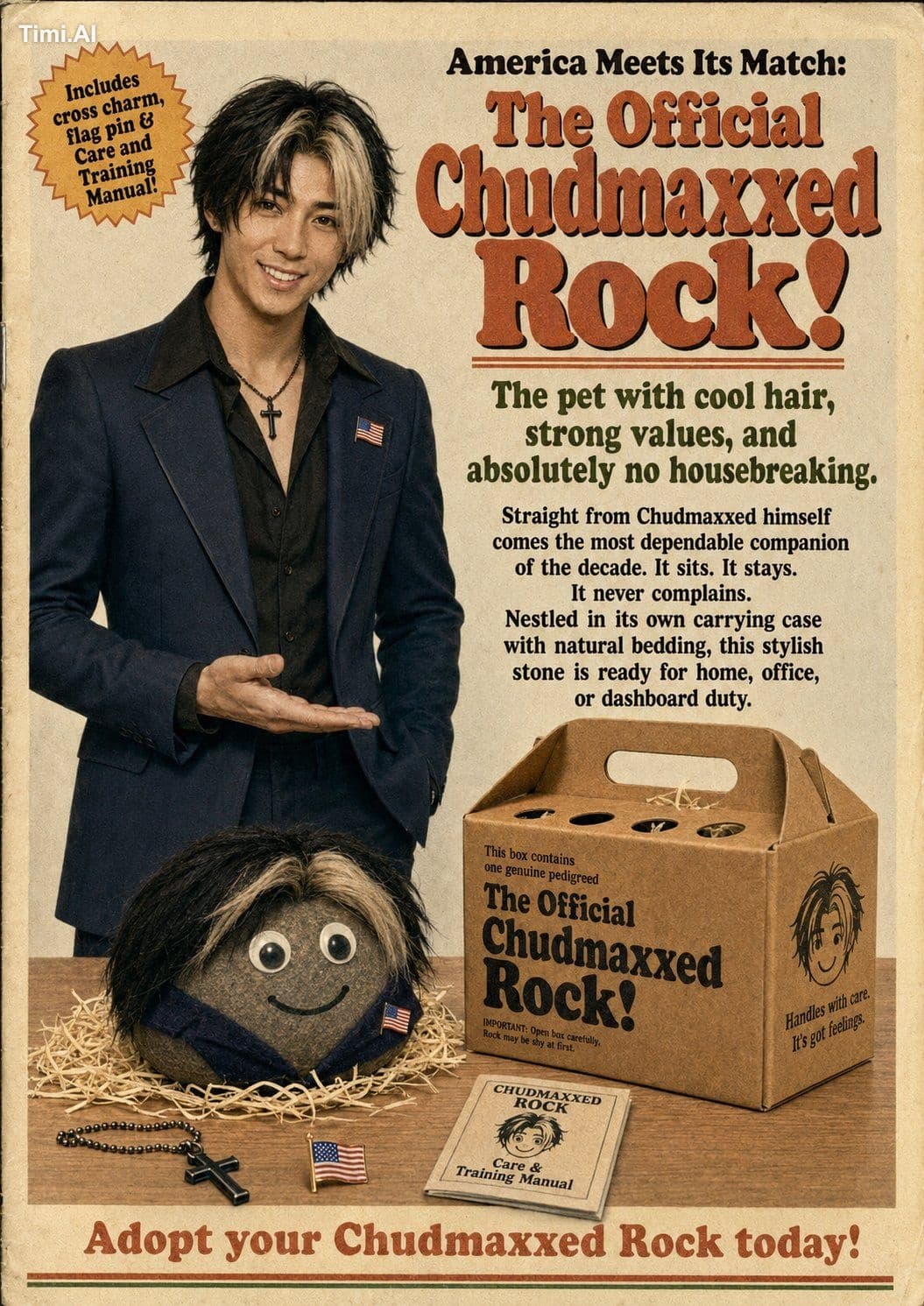
Tick-Tock Goes The Clock! What Time Does It Say It Is? JOLLY'S PROMPT OF THE!!! Have you…
unknown prompt and image example

@joebeanclown
View source post ↗👁 12♥ 0★ quality 90
PROMPTTranslation
Tick-Tock Goes The Clock!
What Time Does It Say It Is?
JOLLY'S PROMPT OF THE!!!
Have you ever wanted your own Pet Rock?!
no?...what do you mean no? well your getting this prompt anyway don't be weird! 🤣
Special Thanks to @ChudMaxxed007 , @CatgirlCareLine and @NamikaVT for being modals.
1970's Pet Rock by Jolly Joebean
Prompt Start
-------------------------
CHARACTER NAME: [insert character name here or leave blank to have a random name generated]
Designate the attached image as @Image1.
@Image1 = primary character reference and identity source.
Using @Image1, create a single, cohesive image styled as an authentic, period-accurate 1970s magazine print advertisement. The ad showcases a novelty "Pet Rock" version of the character, its custom packaging, and its themed accessories, while featuring a photorealistic version of the character from @Image1 acting as the celebrity product spokesperson pitching their new creation.
NAME LOGIC:
- If a CHARACTER NAME is provided above, use it as the product's official name in the advertisement copy and on the box (e.g., "The Official [Name] Rock!").
- If left blank, analyze @Image1's visual design, theme, or expression to generate a humorous, fitting 1970s-style pet rock name (e.g., "Rocky MCQ", "The Cosmic Pebble"), and use that title consistently across the advertisement.
---
CHARACTER IDENTITY & SPOKESPERSON RULES — HIGHEST PRIORITY
Deeply analyze @Image1 first. Extract their hairstyle, face structure, eye color, signature accessories, core color palette, and personality expression. You will use these traits to construct two distinct elements within the same advertisement frame:
1. THE ADVERTISING PRESENTER (THE CHARACTER):
- Show a photorealistic, real-world human/humanoid version of the character from @Image1 standing or posing in the advertisement as the product's creator or celebrity spokesperson.
- Even if @Image1 is stylized (anime, cartoon, comic), translate them into a completely photorealistic, living person for this role.
- Preserve their exact hairstyle, hair color, eye color, facial structure, and iconic wardrobe motifs, but render them using realistic physical textures (real hair strands, natural skin texture, physical fabric folds).
- Dress them in a 1970s-adapted version of their original outfit (e.g., modifying cuts to match 70s lapels, textures, or silhouettes while keeping their signature color palette and motifs recognizable).
- Give them an enthusiastic, charismatic, or deadpan 1970s commercial pitchman expression, looking directly at the camera/viewer.
2. THE PET ROCK VERSION:
- In the center or foreground of the ad layout, display the product: a literal, natural, smooth gray or brown river rock that has been minimally modified to look like a comedic, abstract version of @Image1.
- The rock must feature classic 1970s plastic googly eyes or a simple painted facial expression that humorously mimics @Image1's signature eyes and expression.
- Apply minimalist physical additions to the stone to represent the character's most iconic features (e.g., a tiny wig made of yarn or faux-fur matching their hairstyle/color, a miniature felt version of their hat, or their signature facial markings crudely painted onto the rock's surface).
- The rock must look like a real, tangible, hand-made novelty item from 1975—not a CGI creation or a complex sculpture.
---
PRODUCT PACKAGING & ACCESSORIES
The advertisement must prominently showcase the complete Pet Rock retail package alongside the stone itself:
- THE BOX: An authentic light-brown die-cut cardboard carrying case with a small handle at the top. The box must feature distinct, realistically cut breathing holes on the sides so the rock can "breathe." Inside the box, nesting wood shavings or natural dry straw must be visible, acting as the rock's bed.
- THE ACCESSORIES: Display 2 to 3 miniature, character-specific novelty accessories scaled specifically for the stone. These should be 1970s-era material equivalents of the character's gear (e.g., if the character uses a sword, show a tiny plastic or cheap tin toy sword; if they wear a cape, show a small scrap of matching fabric tied around the rock with a piece of twine; include a tiny printed "Care and Training Manual" featuring retro typography).
---
1970s MAGAZINE ADVERTISEMENT COMPOSITION & LAYOUT
Arrange the entire image to look exactly like a scanned page from a vintage 1970s consumer magazine (such as Time, Life, or Tiger Beat):
- LAYOUT: Use a classic print ad grid. Place the photorealistic spokesperson character to one side or in the upper half holding the product or gesturing toward it. The main product shot (the rock, box, straw, and accessories) should be clearly displayed on a flat surface in the foreground.
- TYPOGRAPHY: Include bold, retro 1970s display typography for the headlines and product taglines (utilizing classic period-accurate type styles like Cooper Black, ITC Souvenir, or tight, heavy serifs with distinct drop shadows). The text should read with authentic promotional pitches based on the character's name.
- TEXTURES & PRINT QUALITY: The entire composition must have a tangible print medium quality. Apply subtle vintage paper grain, ink bleed, slight color registration offset, a matte paper texture, and the faint, warm discoloration typical of aged pulp paper from the mid-1970s.
---
LIGHTING, PALETTE, AND MOOD
- LIGHTING: Use warm, slightly muted, high-contrast studio photography lighting typical of 1970s commercial layouts. Avoid pristine modern digital lighting or dramatic cinematic shadows.
- COLOR PALETTE: Heavily favor an authentic 1970s color grading system. Lean into rich, warm earth tones including harvest gold, avocado green, burnt orange, warm browns, and cream tones, blending @Image1's primary color identity into this retro palette.
- MOOD: Wholesome, slightly absurd, nostalgic, and delightfully campy—perfectly capturing the peak novelty craze of the mid-1970s.
---
DO NOT
- Do not keep the spokesperson character in an anime, comic book, or stylized art format; they must be fully translated into 1970s photorealism.
- Do not make the Pet Rock a high-tech sculpture, 3D digital model, or living creature—it must look like an ordinary, inanimate river stone with cheap novelty decorations glued to it.
- Do not use modern typography, digital sans-serif fonts, or clean vector layouts.
- Do not include modern technology, smartphones, digital interfaces, or contemporary backgrounds.
- Do not make the image a clean digital illustration; it must look like a physically printed, aged, and scanned paper magazine page.
- Do not include modern trading card frames, UI overlays, bar codes, or website URLs.
- Do not render distorted anatomy, malformed hands on the spokesperson, or messy/unreadable main text titles.
---
Prompt End
Turn this look into your image
#vintage advertisement#1970s style#pet rock#magazine ad#celebrity endorsement#novelty product
Related prompts
✨ View prompt♥ 1108
✨ View prompt♥ 1020

✨ View prompt♥ 99
✨ View prompt♥ 268

✨ View prompt♥ 78
✨ View prompt♥ 56
✨ View prompt♥ 179

✨ View prompt♥ 77
✨ View prompt♥ 90
✨ View prompt♥ 63
✨ View prompt♥ 84
✨ View prompt♥ 56