
unknownPosters & Visuals
Please use @image1 as the primary, mandatory character reference image. @image2 is an op…
unknown prompt and image example

@EvaGlitchAI
View source post ↗👁 7,507♥ 114★ quality 93
PROMPTTranslation
Please use @image1 as the primary, mandatory character reference image.
@image2 is an optional second character reference image.
Important branching rules:
@image1 is mandatory.
If @image2 is absent, use only the character from @image1 and ensure a solo composition with only one person.
If @image2 is present, use both the character from @image1 and the character from @image2, and ensure a two-person composition.
If @image2 is absent, do not fabricate a second person or duplicate the @image1 character to act as an opponent.
If @image2 is present, do not omit the @image2 character.
If one image is input, only one person; if two images are input, only two people. Strictly adhere to this headcount rule.
Output format:
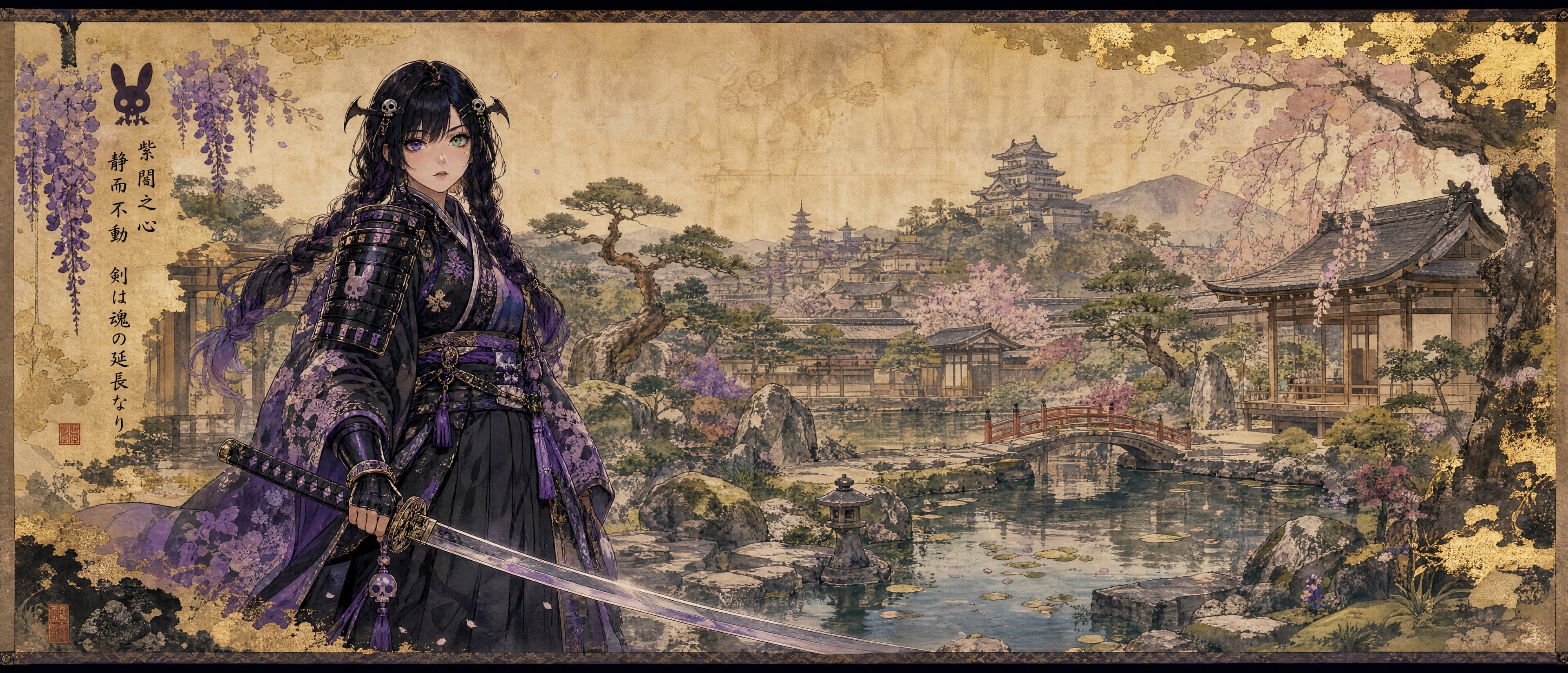
21:9 ultra-wide image.
Composition should resemble a horizontal picture scroll (emaki), gold folding screen (byobu), hanging scroll tapestry, or traditional Japanese painting.
Art style:
Depict the entire image in the style of traditional Japanese art: samurai scrolls, folding screen paintings, hanging scrolls, and washi paper tapestries.
Use expressions reminiscent of watercolor, ink wash, mineral pigments (iwa-enogu), Japanese painting (nihonga), washi paper, and gold leaf.
The appearance should be that of a classic, elegant Japanese artwork, not a modern digital background.
Expressive elements:
Washi paper texture and fiber feel.
Ink brushwork.
Watercolor bleeding.
Elegant and deep coloration like mineral pigments.
Soft gold leaf-style decorations.
Horizontal composition utilizing negative space.
Eye-guiding flow from left to right like a picture scroll.
Decorative and elegant background composition like a folding screen painting.
Color rules:
Colors should not be too dull; ensure the background and characters are clearly legible.
While maintaining the softness of watercolor, the colors should be elegant, beautiful, and slightly rich.
Use colors typical of Japanese painting: vermilion, deep crimson, indigo, ultramarine, jade green, young grass green, cherry blossom pink, wisteria purple, white, ink black, gold-brown, and pale gold.
Do not make the overall image gray, muddy, or look like ruins.
Character transformation rules:
Reinterpret the characters as formal samurai warriors.
Maintain each character's facial features, hairstyle, hair color, eye color, physique, silhouette, racial traits, accessories, costume motifs, signature colors, and overall atmosphere.
Even when converted into samurai attire, ensure the original reference character is clearly recognizable.
Do not redesign them into different people.
Samurai design:
Reconstruct each character as a samurai unique to them.
Without losing the original character's colors, hairstyle, decorations, costume shapes, accessories, racial traits, or overall vibe, naturally incorporate haori, hakama, light armor, obi, hand guards (tekko), straw sandals (zori), Japanese-patterned fabrics, and family crest-style patterns.
Draw the katana as a beautiful Japanese sword, carefully depicting the hilt wrapping (tsukamaki), handguard (tsuba), scabbard, lacquer texture, hanging cord (sageo), and decorative metal fittings.
The sword should be visually appealing, elegant, and beautiful as a craft object.
The samurai attire should not be generic cosplay, but authentic samurai design that naturally exists within the world of traditional Japanese art.
Background and environment:
The background should not be desolate ruins or battlefields, but a beautiful, well-maintained Japanese garden and traditional architecture.
The location should be a samurai residence garden, temple garden, courtyard, garden adjacent to a dojo, or a formal Japanese garden.
Beautifully incorporate elements such as pond gardens, stone lanterns, stepping stones, arched bridges, moss gardens, white sand, pine trees, cherry blossoms, autumn leaves, bamboo, wooden corridors, tiled roofs, gates, tea houses, and temple/shrine architecture.
In the far distance, include beautiful scenery such as traditional Japanese castle towns, capitals, rows of temple roofs, or mountain ranges.
The background should not be a blurred void, but clearly readable as a beautiful Japanese garden, architecture, or urban landscape.
Scene branching:
[If @image2 is absent = 1-person composition]
The main character to draw is only the character from @image1.
Do not include other main characters, opponents, or sparring partners.
Do not increase the @image1 character by duplicating, cloning, mirroring, creating alternate poses, or distant versions.
Place the character on the left side of the screen.
The composition should show the character in beautiful samurai attire, posing alone.
The pose should be one that stands on its own, such as standing quietly, holding a sword in a stance, just before drawing the sword, practicing alone in the garden, steadying their breath, or focusing their spirit.
On the right side, show a wide, beautiful Japanese garden, traditional architecture, and a distant castle town.
The 1-person composition should be a beautiful, display-worthy piece that balances a "samurai character portrait" with a "magnificent Japanese garden scene."
In a 1-person composition, do not create an opposing partner or combatant.
[If @image2 is present = 2-person composition]
The main characters to draw must be exactly two.
Left character = @image1 character.
Right character = @image2 character.
Clearly draw @image1 and @image2 once each as distinct individuals.
Do not omit either; both must be clearly visible.
Do not finish by drawing only one person.
The two should be facing each other in a composition of friendly practice, respectful sparring, or light training.
This should not be a fight to the death or a duel with strong hostility, but a quiet and beautiful interaction between skilled samurai.
Place one person toward the left edge and the other toward the right edge.
Leave a wide garden space between the two, and create a scenic highlight in the center as well.
Both should be sufficiently large, readable, and have recognizable silhouettes.
The two characters' hairstyles, costumes, colors, swords, physiques, and silhouettes should be distinguishable from each other.
Do not duplicate one person to make it look like two.
Do not merge the two people.
Composition:
21:9 ultra-wide tapestry composition.
Divide into foreground, middle ground, and background to create a sense of depth typical of a picture scroll.
Ensure the characters, garden, architecture, and distant townscape flow naturally from left to right.
The characters should be clearly readable, and the background should be rich and beautiful without overshadowing the main subjects.
Do not lose the background; ensure the scenery on the right and center is also worth viewing.
Lighting and mood:
Use soft morning light, clear spring light, golden evening light, or diffused light from a calm, cloudy sky.
Add reflections on water surfaces, paper textures, pale mist, and the soft glow of gold leaf.
The mood should be serene, elegant, refined, traditional, poetic, and possess a calm tension.
Do not make it dark or desolate; keep it a beautiful and well-ordered traditional Japanese world.
Quality:
High-quality illustration in the style of traditional Japanese painting.
Achieve a level of completion like a picture scroll, gold folding screen, hanging scroll, or washi tapestry.
Ensure the characters, swords, gardens, architecture, and distant townscapes are all easily readable.
Clearly express brushwork, watercolor bleeding, washi texture, mineral pigment-style coloration, and elegant decorativeness.
Create a sophisticated composition that stands as display-worthy art.
Do not:
Do not add a second person when @image2 is absent.
Do not duplicate, clone, mirror, or create alternate poses of the @image1 character when @image2 is absent.
Do not make the 1-person composition a confrontation when @image2 is absent.
Do not omit the @image2 character when @image2 is present.
Do not draw only one person when @image2 is present.
Do not finish by drawing only the @image1 character when @image2 is present.
Do not draw anything other than one person if one image is input.
Do not draw anything other than two people if two images are input.
Do not redesign characters into different people.
Do not lose the original character's hairstyle, hair color, eye color, physique, silhouette, racial traits, or accessories.
Do not make the samurai attire look like cheap generic cosplay.
Do not make the sword look like an ambiguous weapon or a stick that is too short.
Do not make the background ruins, battlefields, collapsed remains, desolate temples, or neglected gardens.
Do not make the background too thin, too blurry, too empty, or unreadable.
Do not make the colors too dull or sink the entire image into gray or muddy tones.
Do not include modern buildings, neon, cars, power lines, smartphones, firearms, or futuristic machinery.
Do not include Western-style castles, knights, churches, Gothic architecture, or Western fantasy ruins.
Do not use photorealistic expression.
Do not include bloody combat, cruel violence, or killing.
Do not make the 2-person composition a duel with strong hostility. Maintain the air of friendly practice or sparring.
Do not make characters too small, hidden, blurry, or unreadable.
Do not make the background excessively noisy compared to the characters.
Do not create extra limbs, collapsed faces, distorted anatomy, or muddy textures.
Do not use a composition other than 21:9.
Turn this look into your image
#samurai#japanese art#scroll painting#wisteria#castle#fantasy#character art#ink wash
Related prompts
✨ View prompt♥ 1108
✨ View prompt♥ 1020
✨ View prompt♥ 268
✨ View prompt♥ 56
✨ View prompt♥ 179
✨ View prompt♥ 63
✨ View prompt♥ 84

✨ View prompt♥ 56

✨ View prompt♥ 30
✨ View prompt♥ 38
✨ View prompt♥ 55
✨ View prompt♥ 15